Employee Advocacy
Your advocacy program is failing because you’re forcing it
Most companies already have engaged employees
who believe in their work.
The problem isn’t motivation, it’s approach.
Is this you?
Invisible expertise
Your best people are brilliant at what they do, but invisible in the market. Competitors with weaker teams are getting all the attention because they show up where buyers are looking.
Failed attempts
You’ve tried employee advocacy before. Maybe you bought a platform, ran a pilot, or encouraged people to share company content. Adoption was low. Engagement dropped. The program quietly died.
Competitors pulling ahead
You can see competitors’ employees building audiences, generating leads, and attracting talent through LinkedIn. Your team watches from the sidelines, unsure how to start or afraid of getting it wrong.
Declining organic reach
Your company page reach keeps dropping. Your marketing team creates great content, but the algorithm buries it. You know employee networks could amplify it, but you can’t crack the code.

The old playbook stopped working
For years, B2B companies could rely on a predictable formula: invest in brand advertising, optimise the company page, push content through corporate channels, and let sales do the rest.
That playbook is broken. Customer acquisition costs have risen 222% in eight years. Company page organic reach sits below 2%. And 77% of buyers say they trust employee voices more than brand messages.
The companies that are winning aren’t spending more on the same broken channels. They’re activating the one asset their competitors can’t replicate: their people.
Company pages: <2% organic reach
CAC up 222% in 8 years
77% trust employee voices

Mandated advocacy creates compliance, not advocates
Most employee advocacy programs fail for the same four reasons. Recognising these patterns is the first step toward fixing them.
01
The approach problem
You treat advocacy as a marketing channel instead of a people program. Employees are asked to distribute content they didn’t create, about topics they don’t care about, in a voice that isn’t theirs.
02
The value problem
There’s no personal benefit for the employee. They see the company benefiting from their network, their credibility, and their effort, but nothing comes back. It feels extractive, because it is.
03
The content problem
You give people pre-written content and expect authenticity. But audiences can spot corporate copy-paste from a mile away. The content doesn’t perform, which confirms the employee’s suspicion that it was pointless.
04
The treatment problem
You treat everyone the same. The executive who wants to build a personal brand, the engineer who prefers to stay behind the scenes, and the sales rep who wants leads all get the same program. None of them get what they need.
The problem isn't your people. It's the program design.
The cost of waiting
Every month you delay, your competitors' employees are building the relationships that should be yours. They're becoming the trusted voices in your industry. They're attracting the talent you're trying to hire. They're generating the pipeline you're paying agencies to create.
The gap between companies with activated employees and those without isn't closing. It's accelerating. The early movers aren't just ahead; they're making it harder for everyone else to catch up.
This isn't about LinkedIn trends or social media marketing. It's about whether your organisation's collective expertise is visible to the people who need to see it. Right now, it probably isn't.
The question isn't whether employee advocacy works. The evidence is overwhelming. The question is whether you'll build it on a foundation that lasts, or keep cycling through programs that don't.
There's a better way. And it doesn't require forcing anyone.
From forcing advocacy to facilitating it
The shift starts with a simple insight: people don't resist visibility. They resist being told how to be visible. When you remove the friction and add genuine value, advocacy becomes natural.
What real advocacy looks like
The engineer who writes
She never wanted to be an influencer. But when she started sharing technical challenges her team solved, engineers at target accounts started reaching out. Two became customers.
The executive who shows up
He was sceptical about LinkedIn. After learning to share his perspective on industry trends in his own voice, he became the first call for journalists covering the sector.
The team that amplifies
They don't create content. They engage meaningfully with colleagues who do. Their comments and conversations extend reach by 300% without anyone writing a single post.
Not everyone advocates the same way
That's why we built the VIBE framework. It segments your team into four advocacy levels, each with clear expectations, appropriate support, and genuine value exchange.
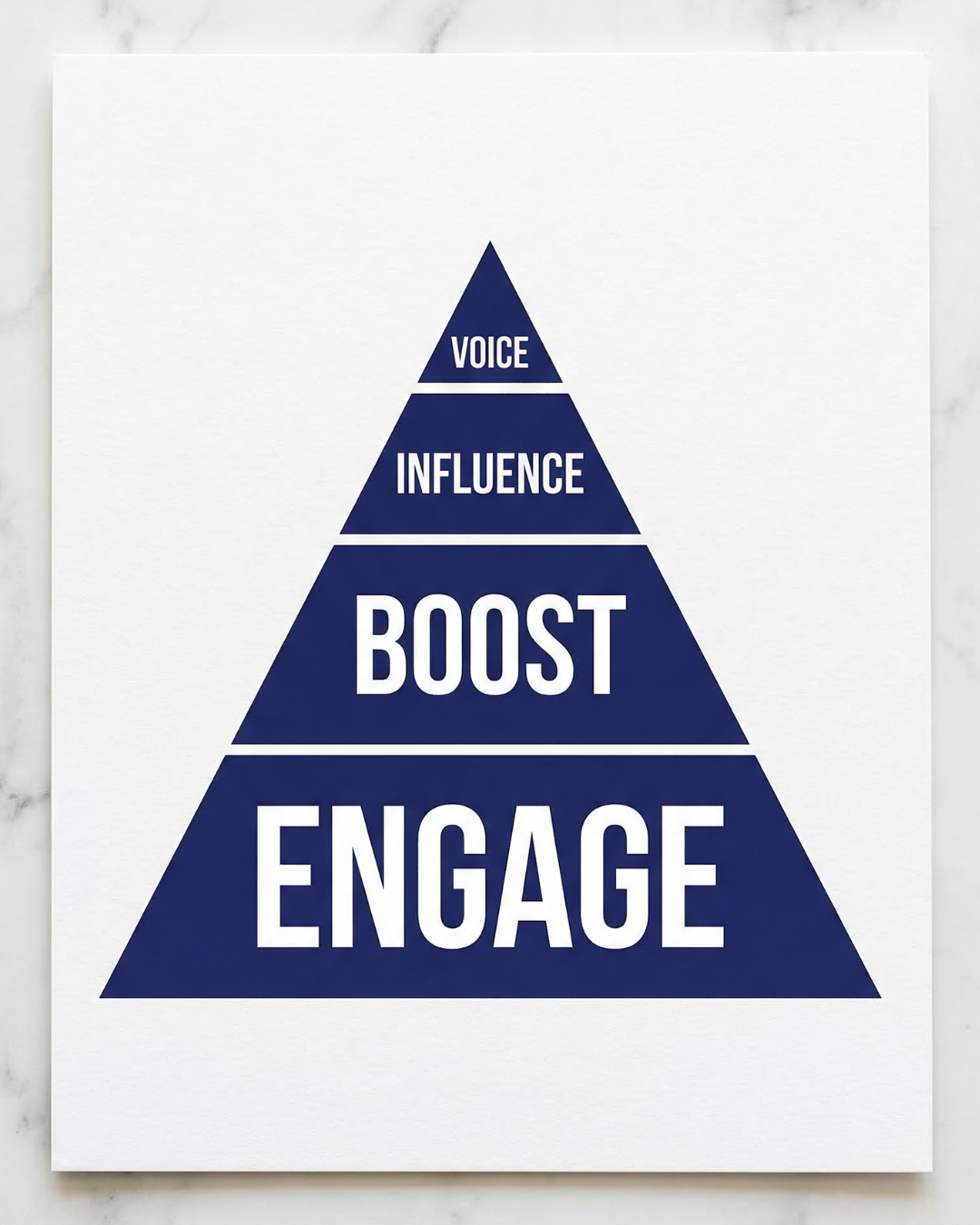
Voice — 1-3%
Deep experts building professional authority. Original content, original perspectives, event speakers. They need coaching, not scripts.
Influence — 5-10%
Active contributors who share insights and engage in industry conversations. Client-facing roles where visibility supports their work.
Boost — 20-40%
Amplifiers who extend reach through comments, reactions, and shares. Minutes per week. No content creation pressure.
Engage — 40-60%
External partners and affiliates who extend your reach for key announcements and strategic campaigns.
Why VIBE works
Because it stops treating everyone the same. Your CEO and your junior developer don't need the same program. VIBE gives each person a role that matches their willingness, ability, and position. No one is forced. Everyone contributes.
Choose the path that fits your team
Whether you're exploring, building capability, or looking for ongoing support — we have a format that matches where you are today.
Insights
Keynote or Masterclass
A company-wide session that motivates employees across all levels to become advocates and shows what authentic employee voices can deliver for the organisation.
✓ 75-minute session
✓ Unlimited participants
✓ Available as keynote or interactive masterclass
Knowledge
Strategy Consultancy
A series of short masterclasses for your employee advocates, or a consultancy track for marketing and communications leadership to align your advocacy strategy with company objectives.
✓ Tailored to your industry and market
✓ Strategy consultancy: for marketing/comms leadership
✓ Align advocacy with business objectives
✓ VIBE framework and role matching
Skills
Training Program + Coaching
Full training cohorts tailored to each VIBE level, combined with coaching and tooling so your advocates can contribute consistently at a level that matches their capacity.
✓ Training cohorts per VIBE level
✓ Add group or individual coaching
✓ On-site blended option available
✓ Max 15 participants per cohort
Proven with teams like yours
Case Study: Capgemini Executive Advocacy Program
52+ senior executives went through a tailored Thought Leadership program.
They published 697 posts collectively, and their LinkedIn profiles improved by an average of 65.85%.
The program proved that even time-poor executives will engage when the approach is right.
You might be thinking...
"We tried advocacy before and it didn't work."
Most advocacy programs fail because they treat employees as distribution channels. They push pre-written content, measure shares instead of impact, and offer no personal value. Our approach is different. We start with the employee's goals, match them to a role that fits their comfort level (VIBE), and build habits that last beyond the program. That's why our completion rates exceed 90%.
"Our employees won't participate."
They won't participate in a program that treats them as megaphones for corporate messaging. But they will engage when they see personal value: career growth, professional visibility, skill development. The VIBE framework means nobody is asked to do something that doesn't fit them. The engineer who hates writing can still be a powerful advocate through engagement alone.
"We don't have time for another program."
This isn't another program to manage. It's a system that runs on its own once habits are built. Our training is designed for busy professionals: focused sessions, practical outputs, and immediate application. Most participants spend less than 30 minutes per week and see measurable results within the first month.
"How is this different from buying an advocacy platform?"
Platforms are tools. They solve the distribution problem but not the adoption problem. You can have the best advocacy platform in the world, but if people don't want to use it, it's expensive shelfware. We solve the human side first: motivation, skills, confidence, and habit formation. Then, if a platform makes sense, it amplifies what's already working.
Ready to activate your team?
Tell us about your organisation, your goals, and where you're stuck. We'll share what's possible.
Or choose your starting point
Keynotes & Masterclasses
75 minutes to shift how your team thinks about visibility, trust, and business growth. The wake-up call that starts the conversation.
Explore keynotes →
Consultancy & Strategy
LinkedIn audits, advocacy strategy, and micro masterclasses. Get clarity and a roadmap before committing to a full program.
Explore consultancy →
Training and Coaching
Cohort-based programs that build lasting habits. Max 15 per group. 3-6 modules of hands-on skill building with real output.
Explore training →